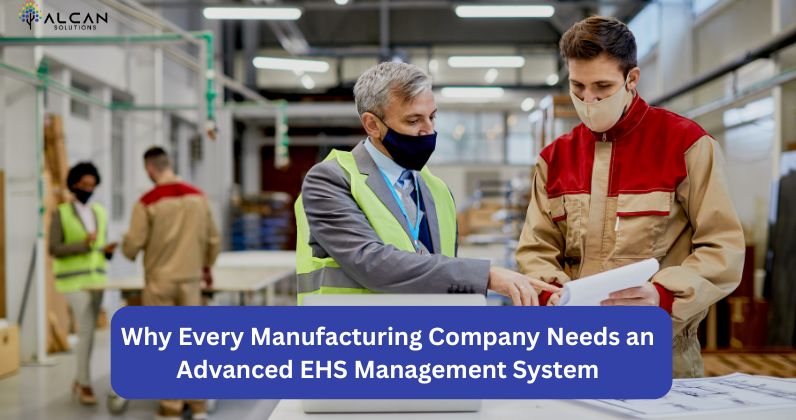
In the current challenging industrial environment, manufacturing businesses are under growing pressure to sustain high productivity levels while ensuring workplace safety, environmental stewardship, and regulatory requirements. With their complex processes, dangerous substances, and stringent regulations, manufacturing businesses cannot afford to follow traditional safety procedures or track compliance manually. This is where an advanced Environmental, Health, and Safety (EHS) Management System comes into play.
An advanced EHS management system is more than a compliance solution. It is a comprehensive solution that combines workplace safety, environmental monitoring, risk management, and reporting into a single, centralized system. For manufacturing businesses, it is no longer a choice but a necessity for long-term success and growth.
The Growing Complexity of Manufacturing Operations
Contemporary manufacturing plants involve complex equipment, several production lines, and varying employee populations. As the scale of operations increases, so does the risk of safety and compliance issues. Starting with chemical exposure and machinery-related accidents to waste treatment and emission controls, manufacturers are faced with a broad spectrum of potential risks.
Manual record-keeping and unconnected systems tend to result in data discrepancies, reporting issues, and potential compliance problems. An advanced EHS management system integrates all safety and environmental information into a single platform.
Ensuring Regulatory Compliance
Manufacturing firms are required to adhere to local, national, and international regulations concerning workplace safety and environmental protection. Failure to comply with these regulations may lead to hefty fines, lawsuits, and even the closure of manufacturing facilities.
An effective EHS solution assists manufacturing firms in adhering to regulations in the following ways:
- Regulatory tracking and updates are automated
- Accurate documentation is maintained
- Compliance reports are produced in real-time
- Audits and inspections are efficiently handled
The use of technology in regulatory compliance eliminates human error and ensures that manufacturing firms are always audit-ready.
Workplace Safety
Injuries in the workplace not only affect the employees but also affect the business. Lost days, compensation, damaged equipment, and lost production can affect the bottom line.
An effective EHS management system enhances workplace safety by:
- Proactive identification of potential hazards
- Incident and near-miss tracking
- Risk assessments
- Corrective and preventive actions
- Safety training records
Companies can proactively take preventive measures to avoid incidents by analyzing data and trends.
Enhancing Environmental Responsibility
Environmental sustainability is emerging as a high priority for all stakeholders, customers, and government agencies. The manufacturing process includes waste generation, energy consumption, water usage, and emissions, which need to be managed effectively.
An effective EHS management system helps manufacturers to:
- Track environmental impact metrics
- Handle waste disposal and hazardous materials
- Measure energy and resource consumption
- Facilitate sustainability reporting
The system helps manufacturers to manage environmental data and make their operations more sustainable.
Centralized Data for Better Decision-Making
One of the most significant benefits of an advanced EHS management system is the ability to centrally manage data. This means that instead of having data scattered across various spreadsheets and pieces of paper, all safety and environmental data is managed through one system.
This allows management to:
- View real-time dashboards
- Analyze trends and performance indicators
- Make data-driven decisions
- Improve operational transparency
When management has access to accurate and timely information, they are able to make strategic improvements that increase both safety and productivity.
Reducing Operational Costs
Many manufacturing organizations are reluctant to invest in a modern EHS system because of the costs involved. In reality, the long-term benefits far outweigh the costs of investment.
A good EHS management system can help organizations save costs in the following ways:
- By minimizing workplace accidents
- By reducing insurance premiums
- By avoiding regulatory fines
- By reducing downtime
- By improving process efficiency
Preventive safety measures and streamlined compliance processes will ultimately result in substantial financial gains.
Strengthening Safety Culture
A positive safety culture is a must in manufacturing settings. Workers should be encouraged to take ownership of safe working conditions.
Modern EHS solutions promote a positive safety culture through:
- Facilitating easy incident reporting
- Fostering a culture of transparency
- Offering readily available training materials
- Monitoring employee engagement
When workers realize that safety is supported by effective systems and a strong safety culture, they become more engaged and take ownership of safety.
Supporting Digital Transformation
The manufacturing sector is quickly adopting digital transformation in automation, IoT, and smart factories. An efficient EHS management system is in line with this digital transformation and can be integrated with the existing systems of the enterprise.
The latest EHS solutions can be integrated with:
- ERP systems
- IoT sensors
- Maintenance management systems
- Human resource management systems
Managing Risk Proactively
Risk management is an important consideration in manufacturing processes. Without a proper system in place, risks can remain unidentified until a problem arises.
An effective EHS management system helps with proactive risk management in the following ways:
- Structured risk assessment
- High-risk activity identification
- Accountability assignment
- Mitigation tracking
Manufacturers can ensure that their processes remain stable and accident-free by dealing with risks at an early stage.
Building Trust with Stakeholders
Customers, investors, and government bodies demand transparency in environmental and safety performance. Organizations that show superior performance in EHS enjoy a competitive advantage.
Better EHS solutions enable manufacturers to:
- Prepare comprehensive sustainability reports
- Offer audit-ready documentation
- Highlight safety performance metrics
This is because transparency leads to trust and improved corporate reputation.
Scalability for Growing Businesses
As manufacturing companies expand, their compliance requirements and operational risks also grow. An advanced EHS management system offers scalability, allowing businesses to adapt as they add new facilities, production lines, or international operations.
A flexible system ensures that growth does not compromise safety or compliance standards.
Preparing for the Future
The future of manufacturing will be shaped by more stringent regulations, increased environmental responsibility, and the use of advanced digital technologies. Those manufacturers who implement current best practices in EHS management systems are best equipped to handle the challenges of tomorrow.
Modern systems offer:
- Frameworks for continuous improvement
- Automated regulatory compliance updates
- Real-time risk monitoring and management
- Sustainability management integrated into the system
Manufacturers who invest in technology-enabled EHS solutions will have a safer, more efficient, and future-ready manufacturing operation.
Conclusion
Each manufacturing enterprise, whether small or large, is confronted with intricate safety, environmental, and regulatory issues. The practice of following outdated methods is no longer adequate in today’s highly regulated and competitive marketplace. A sophisticated EHS management system offers the framework, insight, and automation required to safeguard employees, stay on top of regulations, and drive sustainable business success.
In addition to regulatory compliance, these systems improve business efficiency, minimize expenses, and improve corporate reputation. For manufacturers seeking to succeed in today’s ever-changing industry, the implementation of a sophisticated EHS management system is not only a sound decision—it is a necessity for success.